Jul 27, 2026
Open Weights and American AI Leadership
An annotated deep dive into the July 2026 industry letter — what open weights really buy, what they put at risk, and why the hard tradeoff is irreversibility.
A companion analysis to the July 24, 2026 industry letter signed by Andreessen Horowitz, Meta, Microsoft, NVIDIA, Hugging Face, IBM, Mistral, Mozilla, and others.
Summary of the Major Talking Points
The core argument
- The open-source software analogy. Just as open-source code (Linux, Apache, Kubernetes) became the shared foundation of the modern internet and even U.S. government systems, open-weight AI models can become the shared foundation of the AI economy.
- Leadership = ecosystem, not a single model. American AI leadership should be measured by how broadly AI diffuses into factories, hospitals, farms, classrooms, and small businesses — not by which lab holds the top benchmark score in a given quarter.
- Economic access. Open weights let startups, universities, and public institutions build on advanced models without training one from scratch or paying frontier-model prices for every task. "Right model, right job, right cost" is what makes AI economically sustainable at the scale of billions of daily tasks.
- Competition. Open weights create rivalry across the whole stack — model developers, cloud providers, chips, applications, and services — which drives down costs and spreads the benefits of AI instead of concentrating them.
- Customer control and sovereignty. Organizations can run models on their own infrastructure, keep their data, avoid vendor lock-in, and own the value they create through fine-tuned, specialized models.
The risk acknowledgment
- The letter concedes that open weights carry real and distinct risks: once released, weights are beyond the developer's control, and modified versions are difficult to trace or reverse.
- Its rebuttal: prohibition is the wrong response. Defenders (especially in cybersecurity) need access to comparable capabilities; openness enables broad scrutiny, red teaming, and vulnerability discovery.
- Openness as a safety path. Closed models are not inherently safe — they can be breached, misused, or fail invisibly. Concentrating capability in a few closed models creates single points of failure.
The policy asks
- Expand compute access for startups and researchers.
- Invest in shared training assets: datasets, tooling, evaluation frameworks.
- Keep the frontier plural — avoid premature restrictions that push innovation overseas.
- Don't conflate distillation (a legitimate, long-standing model-improvement technique) with misappropriation (unlawful extraction of value from closed models); address the latter with targeted legal frameworks, not sweeping bans on the technique.
The Issues and Risks, Expanded
The letter names the risks briefly. Here is what sits underneath each one, with the mitigations that exist today and their honest limitations.
Risk 1 — Irreversibility: the one-way door
What the letter says: "Once released, the weights are beyond the original developer's control, and modified versions are difficult to trace or reverse."
What that actually means. A model's weights are just a large file of numbers (tens to hundreds of gigabytes). Once that file is on the public internet, it propagates like any file: mirrors, torrents, private copies. There is no recall mechanism. Compare this to a closed model served through an API: if a dangerous capability or a serious flaw is discovered, the provider can patch the system prompt, add a classifier, restrict the endpoint, or take the model down within hours. With open weights, none of those levers exist. Every safety decision must be made before release, based on predictions about how the model might be modified and combined with future tools — predictions that are inherently uncertain.
This is why release irreversibility is the foundational risk from which the others derive. It converts every other risk from "manageable incident" into "permanent condition."
The intuition: a closed model is a tap you can shut off; an open model is a bucket of water already poured into a river.
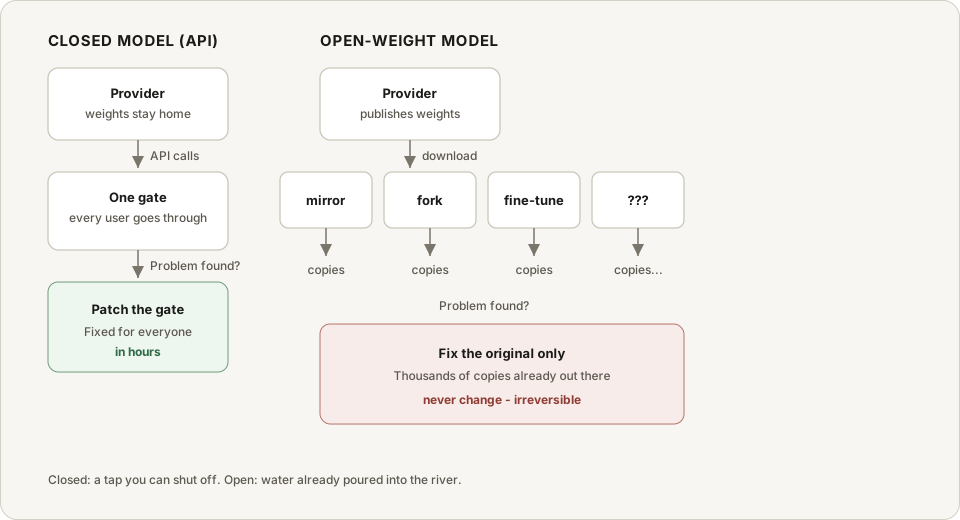
Every other risk in this essay is amplified by this property. It's also why the pre-release evaluation step carries so much weight for open models — it is the only checkpoint that exists.
Workarounds and solutions:
- Pre-release capability evaluations. Labs increasingly run structured dangerous-capability evaluations (cyber-offense, biological uplift, autonomous replication) before deciding whether and what to release. Meta's Frontier AI Framework and similar policies formalize thresholds at which a model would be withheld or released only with restrictions.
- Staged / gated release. Release smaller or intermediate checkpoints first, observe real-world use, then release stronger versions. Or gate downloads behind license agreements and identity checks (as Meta's Llama licenses and Hugging Face's gated-repo mechanism do). This doesn't stop a determined bad actor, but it slows casual misuse and creates a legal hook.
- Marginal-risk framing. The influential question adopted by NTIA's 2024 report on open foundation models: does releasing this model add meaningful risk beyond what is already achievable with existing open models, search engines, and textbooks? If the marginal uplift is small, restriction buys little safety at a large cost to openness.
- Honest limitation: none of these undo a mistaken release. Evaluation science is young, and capabilities are sometimes discovered (or elicited via better prompting/scaffolding) long after release.
Risk 2 — Safety training can be stripped out
What that actually means. Open-weight models ship with safety fine-tuning — refusal behaviors, content filters baked into the weights. But research has repeatedly shown that this alignment layer is shallow relative to the underlying capabilities: with modest fine-tuning (sometimes a few hundred examples and a few dollars of GPU time), the refusal behavior can be largely removed while the model's general competence is retained. "Uncensored" derivatives of popular open models appear on model hubs within days of release. With a closed API model, equivalent jailbreaking is a cat-and-mouse game the provider can keep patching; with open weights, the guardrails are removed once, permanently, in private.
The intuition: safety fine-tuning is a coat of paint on the model, not the steel underneath. Anyone with the car can repaint it.
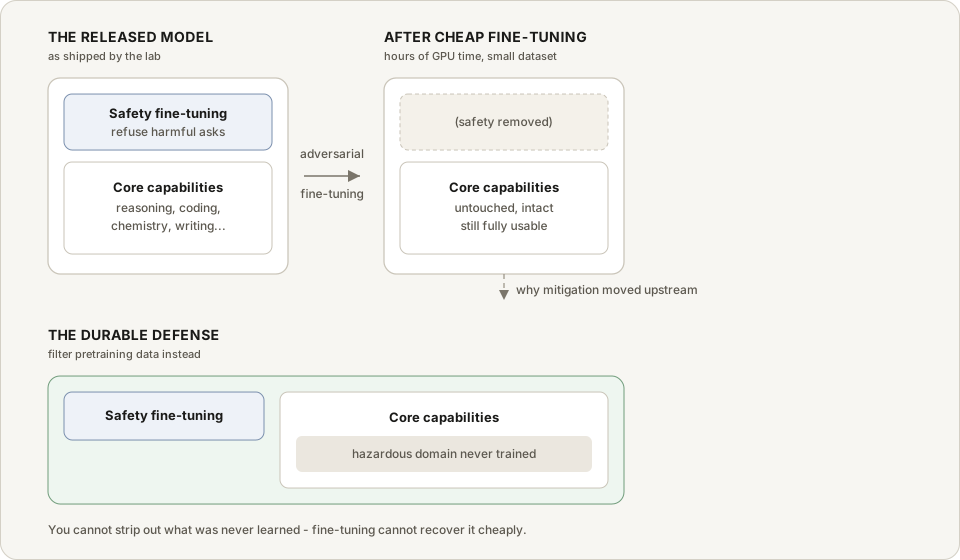
This is the technical reason "the model refuses bad requests" is weak assurance for open weights, and why serious mitigation has moved upstream to data curation and pre-release capability testing.
Workarounds and solutions:
- Tamper-resistant safeguards research. An active research field tries to make safety training harder to remove — e.g., embedding refusals more deeply into representations, "self-destructing" capabilities that degrade under adversarial fine-tuning. Promising, but no method today survives a well-resourced attacker.
- Filter the pretraining data instead. A more durable approach: if hazardous knowledge (e.g., detailed dual-use virology) is excluded from training data, no amount of fine-tuning can cheaply recover what the model never learned. Several labs now curate pretraining corpora for the highest-severity domains.
- Ecosystem-level defenses. Model hubs enforce usage policies and take down clearly abusive derivatives; downstream platforms (cloud hosts, app stores) add their own moderation layers. Defense shifts from the model itself to the surrounding infrastructure.
- Honest limitation: ecosystem defenses only govern public distribution. A private, stripped model on private hardware is invisible.
Risk 3 — Misuse uplift: cyber, bio, and influence operations
What that actually means. The concern is not that models "go rogue," but that they lower the skill floor for harmful activities:
- Cyber offense: vulnerability discovery, exploit development, phishing at scale, malware refinement.
- Biosecurity: step-by-step troubleshooting help that could assist a non-expert through dual-use lab work.
- Influence operations: cheap, fluent, personalized propaganda and impersonation at scale, run on infrastructure no platform can monitor.
The letter's counterargument is the offense-defense balance: attackers will get capable models regardless (including from foreign open models), so denying defenders equal access mainly disarms the defense. In cybersecurity this argument is strong — defenders demonstrably use open models for detection engineering, fuzzing, log triage, and red-teaming, and firms like CrowdStrike (a signatory) build on them. In biosecurity the argument is weaker, because "defense" is not symmetric: a defender can't patch human biology the way they patch software. This asymmetry is why most serious proposals treat bio-uplift as the domain deserving the strictest pre-release scrutiny even while keeping cyber-relevant models open.
The intuition: if lockpicks are already for sale on every corner, banning locksmiths from studying them only helps the burglars.
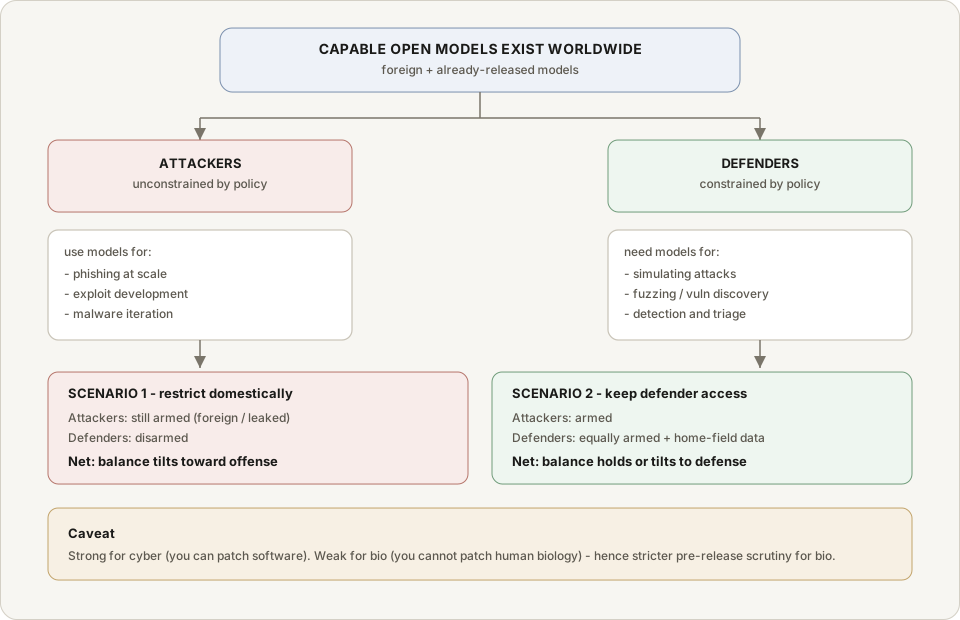
This is the letter's strongest concrete argument for openness — and the caveat is the honest boundary of that argument.
Workarounds and solutions:
- Domain-specific thresholds, not blanket rules. Evaluate and gate by demonstrated hazard domain (the letter's phrase: "protections tied to real and demonstrated harms"), rather than restricting all open models because one domain is scary.
- Defensive acceleration. Deliberately fund defensive applications — AI-assisted patching, biosurveillance, content provenance (C2PA watermarking, though watermarks are removable from open models) — so defensive capability grows at least as fast as offensive.
- Choke points outside the model. For bio, the practical control points are physical: DNA synthesis screening, lab access, export controls on equipment. For cyber: liability, infrastructure takedowns. The model is rarely the only, or best, place to intervene.
Risk 4 — Untraceability and no accountability chain
What that actually means. When a closed model produces harmful output, there is a provider, logs, a terms-of-service violation, an account to suspend. When a fine-tuned derivative of an open model is used for harm on private hardware, attribution is nearly impossible: the modified weights carry no reliable fingerprint, outputs carry no robust watermark (any watermark in an open model can be fine-tuned away), and the chain of custody from original release to misuse is invisible. This complicates both law enforcement and liability doctrine — who is responsible: the original lab, the fine-tuner, the deployer, the user?
Workarounds and solutions:
- Targeted legal frameworks (exactly what the letter proposes for distillation disputes): place liability on the misusing deployer, not on the release of weights per se — analogous to how open-source software licenses disclaim warranty and courts pursue the criminal, not the compiler author.
- Provenance where it can survive: signing and attestation for the distribution channel (model hubs verifying uploader identity, cryptographic hashes of official releases) even if outputs themselves can't be watermarked robustly.
- Compute-level visibility: know-your-customer norms for large training runs at cloud providers, so massive harmful fine-tunes at least leave a trace at the infrastructure layer.
Risk 5 — Concentration risk (the risk the letter turns back on closed models)
What that actually means. The letter inverts the usual framing: the dangerous scenario is not too much openness but too much concentration. If a handful of closed providers mediate all advanced AI, society inherits single points of failure (one breach, one outage, one bad update propagates everywhere), monoculture fragility (every downstream system shares the same blind spots and jailbreaks), unexamined behavior (outsiders can't audit what they can't inspect), and pricing/political power concentrated in a few firms. The open-source security lesson — "transparency can be more secure than obscurity" — is genuine: Linux is more trusted because thousands of independent parties audit it.
The counter-nuance: the analogy is imperfect. Auditing code catches bugs a maintainer can then fix for everyone; auditing weights finds problems that can't be recalled from copies already downloaded. Openness improves scrutiny, but the fix-and-redeploy loop that makes open-source software secure works differently when the artifact is immutable-once-released.
The intuition: one giant dam vs. a network of reservoirs. The dam is easier to guard — but if it breaks, everything downstream floods at once.
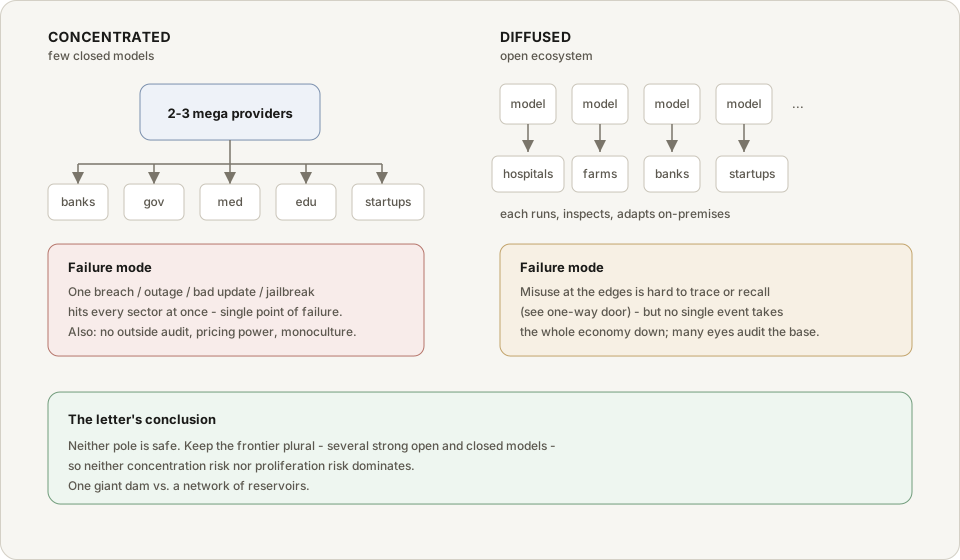
Most public debate treats "open = risky, closed = safe" as the default. The letter's core intellectual move is to show closed concentration carries its own systemic risks — so the policy question becomes balancing two risk profiles, not eliminating one.
Workarounds and solutions:
- Keep the frontier plural (multiple strong labs, open and closed), so neither failure mode — concentration or uncontrolled proliferation — dominates.
- Public benchmarking, red-team ecosystems, and shared evaluation frameworks (a policy ask in the letter) give society the audit benefits of openness while informing which models are safe to release openly.
Risk 6 — Strategic leakage vs. innovation flight
What that actually means. Open weights released by U.S. labs are downloadable in adversary states, contributing to their capabilities. But the letter's implicit response has been borne out repeatedly: restricting American openness doesn't restore control — it cedes the open ecosystem to foreign models (Chinese open-weight models such as the DeepSeek and Qwen families saw explosive global adoption precisely when U.S. open releases lagged). If the world's developers standardize on foreign open models, the U.S. loses the ecosystem influence, safety norms, and talent gravity that come with owning the foundation layer.
Workarounds and solutions:
- Treat openness as an instrument of soft power: the model everyone builds on sets the defaults (safety behavior, values, tooling, language coverage).
- Reserve genuine restrictions for narrow, demonstrably hazardous capability thresholds, and pair them with export-control policy focused on compute, which is physically controllable, rather than weights, which are not.
Closing Note
The letter's position, restated in one sentence: the risks of open weights are real but manageable through targeted, evidence-based safeguards, while the risks of abandoning openness — lost competition, lost sovereignty, disarmed defenders, and a frontier ceded to foreign ecosystems — are structural and harder to reverse. The deepest technical fact underlying the whole debate is the one-way door: openness trades away post-release control in exchange for diffusion, scrutiny, and competition. Every serious policy proposal is ultimately an attempt to get the benefits of that trade while moving the safety work to the only place it can still happen — before release.